


Asbestos can be found in many residential properties, particularly homes built or refurbished before 2000. It was widely used in building materials because of its strength, durability, fire resistance and insulating properties.
For homeowners, landlords and anyone carrying out renovation or maintenance work, knowing where asbestos may be found in a house can help prevent accidentally disturbing asbestos-containing materials.
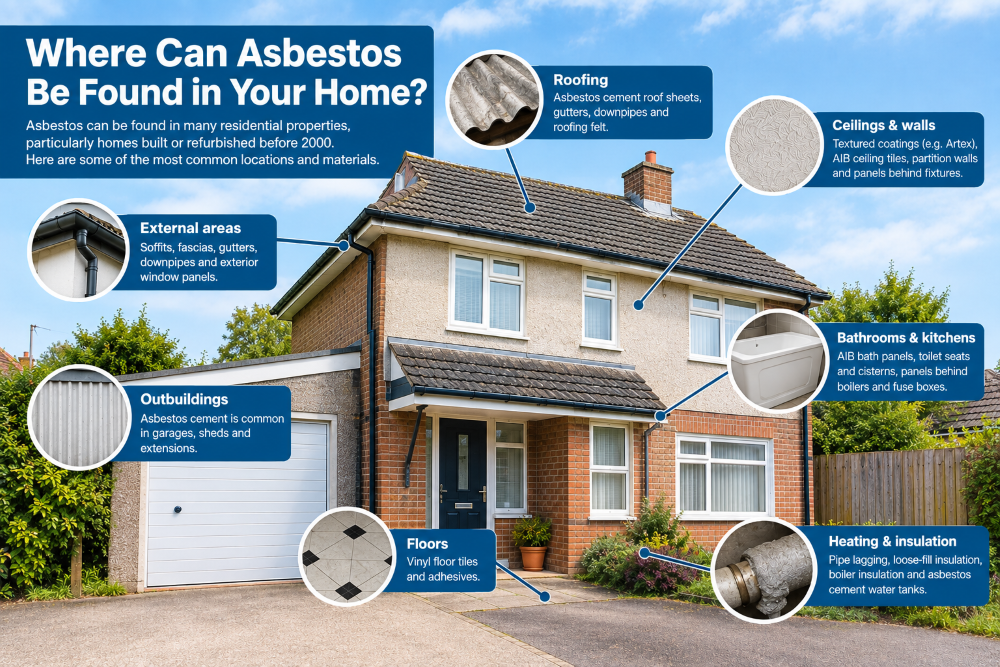
Where is asbestos found in residential properties?
Asbestos was used in a wide range of materials, so it can be found in different areas of a home, including:
Roofs and external areas
Asbestos-containing materials may be present in:
- Asbestos cement roof sheets and panels
- Gutters and downpipes
- Soffits and fascias
- Exterior window panels
- Roofing felt
Asbestos cement is particularly common in garages, sheds, outbuildings and extensions.
Ceilings, walls and partitions
Inside a property, asbestos may be found in:
- Textured decorative coatings, such as Artex
- Asbestos Insulating Board (AIB) ceiling tiles
- Partition walls
- Interior window panels
- Panels behind fires
- Panels around boilers
- AIB behind fuse boxes
Kitchens, bathrooms and utility areas
Potential asbestos-containing materials include:
- Vinyl floor tiles
- AIB bath panels
- Toilet seats and cisterns
- Panels around boilers
- Asbestos cement water tanks
- Pipe lagging
- Loose-fill insulation
Some of these materials may be hidden or difficult to identify by sight.
What does asbestos look like?
Asbestos cannot always be identified simply by looking at a material. Different asbestos-containing products can look very similar to non-asbestos materials.
The age of the property, its construction and the location of a material can provide useful clues, but visual inspection alone cannot confirm whether asbestos is present.
If you are unsure about a material, it should not be drilled, cut, sanded, broken or removed until appropriate advice has been obtained.
When can asbestos become dangerous?
The presence of asbestos does not necessarily mean that a property is unsafe. Materials that are in good condition and left undisturbed may present little immediate risk.
The concern arises when asbestos-containing materials are damaged or disturbed and fibres are released into the air.
This can happen during common home improvement and maintenance work, including:
- Removing flooring
- Drilling into walls or ceilings
- Installing electrical equipment
- Replacing windows
- Altering partitions
- Renovating kitchens or bathrooms
- Removing insulation or other building materials
Asbestos exposure can cause serious diseases, including mesothelioma, asbestos-related lung cancer and asbestosis.
What should you do if you suspect asbestos?
If you suspect that a material in your home contains asbestos, do not disturb it.
Depending on the circumstances, asbestos sampling or an asbestos survey may be appropriate to establish whether asbestos is present before work begins.
For larger refurbishment projects, an appropriate asbestos survey can help identify asbestos-containing materials and provide information needed to plan the work safely.
Where asbestos-containing materials need to be removed, specialist asbestos removal and remediation may be required.
Asbestos surveys and removal services
Bradley Environmental provides asbestos consultancy and asbestos removal and management services for residential and domestic properties.
Our services include asbestos surveys, bulk sample analysis, air testing, asbestos removal and remediation.
If you are planning work on an older property or are concerned that asbestos may be present, our team can advise on the appropriate next steps. Contact us here.